
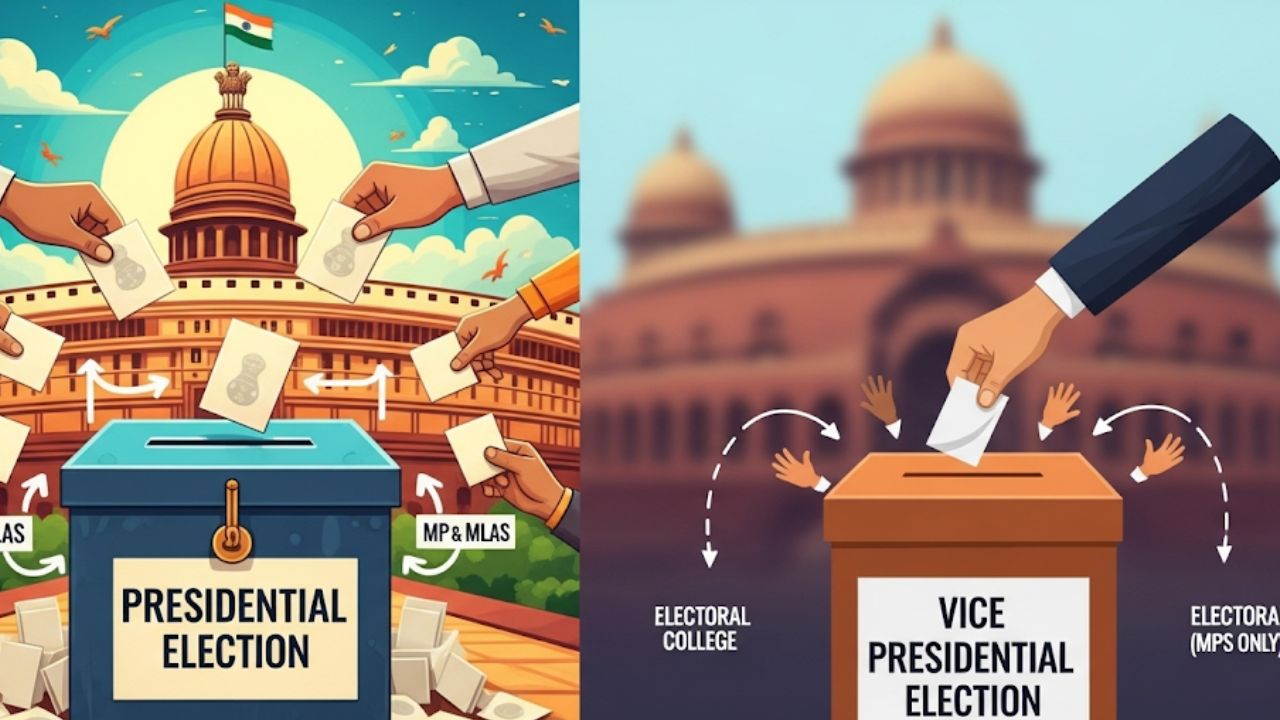
India, being the world’s largest democracy, has a unique system for electing its President and Vice President. These two positions are the highest constitutional offices in the country. The process is defined by the Constitution of India and involves specific articles and schedules. Additionally, there are provisions for their impeachment if they violate constitutional norms.
Who is the President of India?
The President of India is the head of state and the first citizen of the country. While the role is largely ceremonial, the President has important constitutional duties, such as signing bills into law and acting as the supreme commander of the armed forces.
Who is the Vice President of India?
The Vice President is the second-highest constitutional office and serves as the ex-officio Chairman of the Rajya Sabha (the upper house of Parliament). The Vice President also acts as the President when the latter is unavailable.
Election of the President of India
The process of electing the President is outlined in Article 54 and Article 55 of the Indian Constitution, along with the Presidential and Vice-Presidential Elections Act, 1952.
Who Elects the President?
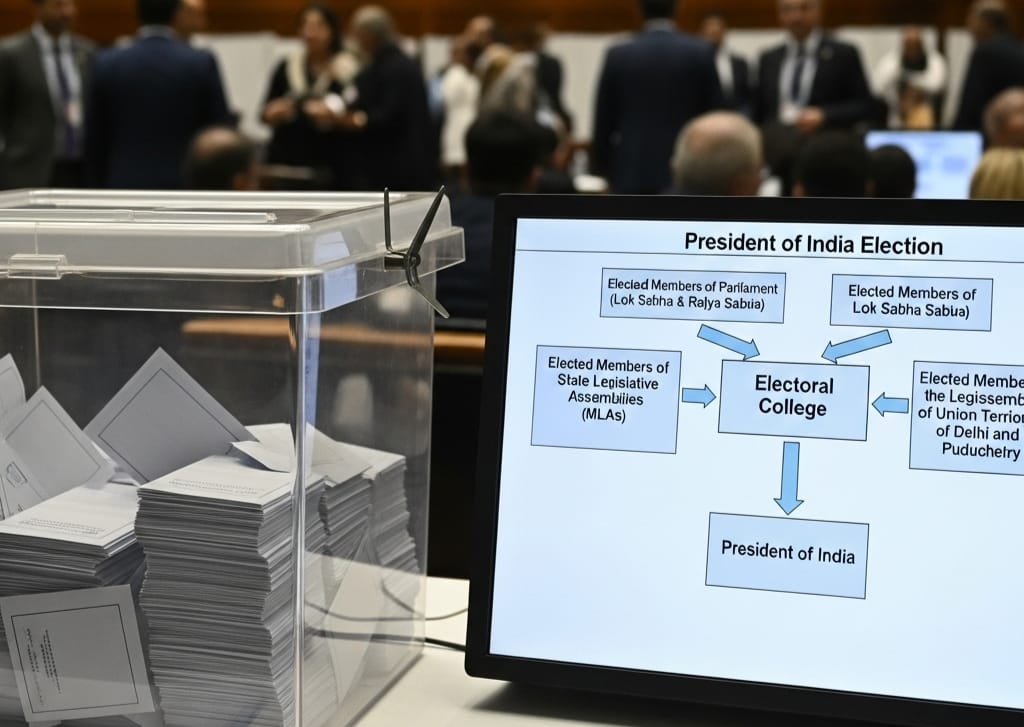
The President is elected by an Electoral College, as mentioned in Article 54. This college includes:
- Elected members of both houses of Parliament (Lok Sabha and Rajya Sabha).
- Elected members of the Legislative Assemblies of all states.
- Elected members of the Legislative Assemblies of Union Territories (Delhi and Puducherry).
Nominated members of Parliament or state assemblies and members of Legislative Councils do not vote in this election.
How is the Voting Done?
The election uses a single transferable vote system with proportional representation, as described in Article 55. Here’s how it works:
- Each voter (member of the Electoral College) casts a vote with preferences.
- The votes are weighted to ensure fairness between states and the central government.
- The value of each vote is calculated based on the population of states (as per the First Schedule of the Constitution).
Vote Value Calculation
- For state assembly members: The vote value is calculated using a formula in Article 55(2):
- Total population of the state ÷ (Number of elected MLAs × 1000).
- For example, a state with a population of 10 million and 100 elected MLAs would have a vote value of 100 (10,000,000 ÷ (100 × 1000)).
- For MPs (Lok Sabha and Rajya Sabha): The total value of votes of all state MLAs is divided by the number of elected MPs to determine the vote value of each MP.
This ensures that smaller states have a proportionate say in the election.
Eligibility for President
Article 58 outlines the qualifications:
- Must be a citizen of India.
- Must be at least 35 years old.
- Must be eligible to become a member of the Lok Sabha (e.g., not disqualified under any law).
- Must not hold any office of profit under the government (except certain exempted posts like Governor or Minister).
Term of Office
As per Article 56, the President serves a term of 5 years but can be re-elected. The President can resign by submitting a letter to the Vice President.
Election of the Vice President of India
The Vice President’s election is governed by Article 66 of the Constitution.
Who Elects the Vice President?
The Vice President is elected by an Electoral College consisting of:
- Elected and nominated members of both houses of Parliament (Lok Sabha and Rajya Sabha).
Unlike the President’s election, state assembly members do not participate.
Voting Process
The voting system is similar to the President’s election:
- A single transferable vote system is used.
- Voters rank candidates in order of preference.
- The candidate with the required majority wins.
Eligibility for Vice President
Article 66 specifies:
- Must be a citizen of India.
- Must be at least 35 years old.
- Must be eligible to become a member of the Rajya Sabha.
- Must not hold any office of profit.
Term of Office
As per Article 67, the Vice President serves a 5-year term and can be re-elected. They can resign by submitting a letter to the President.
Impeachment of the President
The impeachment process for the President is outlined in Article 61. It is a serious process used only if the President violates the Constitution.
Steps for Impeachment
- Initiation: A motion to impeach can be introduced in either house of Parliament (Lok Sabha or Rajya Sabha). It needs the support of at least two-thirds of the members present in that house.
- Notice: The motion must be signed by at least one-fourth of the total members of the house and submitted with a 14-day notice.
- Investigation: The other house investigates the charges. For example, if the motion starts in the Lok Sabha, the Rajya Sabha investigates, and vice versa.
- Voting: If the investigating house finds the President guilty, the motion must be passed by a two-thirds majority of the total membership of that house.
- Removal: If the motion is passed, the President is removed from office immediately.
This process ensures that impeachment is not taken lightly and requires strong evidence of wrongdoing.
Removal of the Vice President
The process for removing the Vice President is outlined in Article 67(b). It is simpler than the President’s impeachment:
- A resolution for removal can be moved in the Rajya Sabha.
- It requires a majority of the total membership of the Rajya Sabha and the agreement of the Lok Sabha.
- A 14-day notice is needed before the resolution is moved.
Important Articles and Schedules
Here’s a quick summary of the constitutional provisions:
- Article 54: Composition of the Electoral College for the President.
- Article 55: Voting process and vote value calculation for the President’s election.
- Article 56: Term and resignation of the President.
- Article 58: Eligibility criteria for the President.
- Article 61: Impeachment process for the President.
- Article 66: Election and eligibility of the Vice President.
- Article 67: Term and removal of the Vice President.
- First Schedule: Lists states and Union Territories, used for vote calculation in the President’s election.
Conclusion
The election of the President and Vice President in India is a well-defined process rooted in the Constitution. Articles 54, 55, 56, 58, 61, 66, and 67, along with the First Schedule, provide a clear framework. The impeachment and removal processes ensure accountability, maintaining the integrity of these prestigious offices. Understanding these processes helps citizens appreciate the democratic principles that govern India.
Also See: Purnima Devi Barman: Saving the Hargila and Empowering Communities
Also See: India’s Green Hydrogen Train: A Step Towards a Cleaner Future
Also See: Poems of Hiru Da: The Heart of Assamese Poetry
Also See: Vice President Jagdeep Dhankhar Resigns, Citing Health Reasons, Under Article 67(a)